
Technology
- Framework’s Data Breach Revealed Customer Data: Here’s What to Know
- 8 Snacks and Guilty-Pleasure Foods Chefs Can’t Live Without
- 'We want photographers to have a proper partner to their camera': Zoner Studio on skipping AI editing gimmicks and the messy reality of shooting
- Ahead of one of the best solar eclipses in years, Telefónica boosts mobile coverage to make sure you can post all your videos online
- TP-Link Roam 7 review: I tested this travel router at my local café, and it turned public Wi-Fi into a secure private network

Custom Search
News
- An arts school where Epstein allegedly preyed on students reveals decades of abuse
- Voters are sick of the two-party system. A new poll shows they're open to big changes
- In a competitive Maine Senate race, women voters could be the deciders
- Mike Lindell touts Trump ties in race for governor of Minnesota, where Trump has lost
- Who really needs testosterone?
Technology
Reviews
- I’d recommend this Switch 2 all-in-one case over Nintendo’s official version having tested them both — and there’s one clear reason why
- TP-Link Roam 7 review: I tested this travel router at my local café, and it turned public Wi-Fi into a secure private network
- I tested the RingConn Gen 3 for two weeks and it's the best choice if you don't want to pay Oura prices
- I watched the behind-the-scenes documentary Disney Worldbuilders and it's inspiring — but I wish they had turned it into a Disney+ series instead
- ‘A capable controller with plenty of adjustments’: while this Nintendo Switch 2 and PC gamepad looks like an Xbox controller, it hides some serious upgrades — but there are a few sticking points you need to know about
New forum topics
It’s the perfect time of year for grabbing a cheap radio for the garden, and they don’t come much cuter, more packed with features or wallet-friendly than this
- Majority unveils its compact Mini Shelford
- It is a DAB+ and FM radio, that also doubles as Bluetooth speaker
- There's a headphone jack, sleep timer and alarm too
Despite the recent death of long-wave, there's a lot to be said for radio listening, so you can tune in to sports broadcasts or catch the news when there's no mobile signal to speak of.
And now Majority has a new option, which is tiny, adorable-looking, as well as being lovely and cheap. This is the Mini Shelford (not to be confused with Great Shelford, a village just outside Cambridge, UK).
Costing just £49 (about $65, AU$100), the Mini Shelford goes on sale in August. It's a smaller version of another Majority radio, called the Little Shelford, with many of the same features but an even smaller footprint.
There are four finishes of the Mini to choose from: black, white, pink or green, and they're all adorable.
Chock-full of featuresAs you'd imagine, the Mini Shelford lets you listen to DAB+ and FM radio. You could still have enjoyed the Wimbledon final if you happened to be in a signal dark spot, then (not that I speak from experience or anything).
But the Shelford also works as a Bluetooth speaker: pairing a device lets you use the speaker to listen to audio content from your phone or other source device. Majority recommends it for "podcasts or audiobooks," implying the drivers aren't really tuned for music that hasn't already been devastated by the FM radio signal.
With a color display, the Shelford offers a few other useful features too, including an alarm clock and sleep timer. It has a headphone jack too, so you can go with wired audio if you want to listen to Radio 4 without anyone else knowing.
As you can probably tell by the name, the Mini Shelford is pretty small; Majority says the footprint is "13cm" though it's not clear what that means, and there's no weight provided.
Either way, it's portable so you can take it into the garden or move it around your bedroom. There's a rechargeable battery, although Majority hasn't announced how long it'll last. How does it sound? Leave it with us, we'd love to find out…
Categories: Technology
Express AI review
Express AI, launched on March 31, 2026, is ExpressVPN's attempt to answer a question many AI users haven't thought to ask: who can read your chats? The platform offers access to five AI models inside a confidential computing environment, where prompts and outputs are cryptographically isolated from everyone, including ExpressVPN itself. That's a bold claim in a category where privacy policies tend to be long on language and short on enforcement.
The platform comes bundled with ExpressVPN's Pro plan at no additional cost, positioning it alongside the company's password manager, secure mail, and identity protection tools. I've been covering AI platforms and business software for TechRadar Pro for years, including our 2026 buying guide for vibe coders and our guides on OpenClaw and Moltbook.
For this review, I spent time using Express AI across a range of everyday tasks: drafting, summarising documents, and reasoning through technical problems, to see how it holds up against better-known AI platforms.
What is Express AI?Express AI is a multi-model AI chat platform built by ExpressVPN and accessible at app.expressai.com. At launch, it offers access to five general-purpose AI models, each selected for a different task type. What separates it from platforms like ChatGPT or Claude isn't the model lineup, but the underlying architecture: every interaction runs inside a confidential computing environment where encryption keys are generated inside the hardware itself, mathematically isolating conversations from cloud providers, model operators, and ExpressVPN.
The platform targets professionals and individuals who routinely share sensitive information in their AI chats, such as financial questions, work documents, and personal communications, and want guarantees that their data won't be retained or used to train future models. It's particularly well-suited to users already in the ExpressVPN ecosystem, since access is tied to the Pro subscription.
Privacy claims in the AI space are easy to make and hard to verify, which is why ExpressVPN commissioned an independent audit from Cure53, a German cybersecurity firm known for rigorous assessments. The pre-launch review, conducted in February and March 2026, covered penetration testing, source code inspection, and analysis of the platform's cryptography and key management. Cure53 confirmed that Express AI processes user interactions within confidential computing enclaves and found no unresolved vulnerabilities at launch.
Express AI: At a glanceAttribute
Notes
Underlying model(s)
Five open-weight models: GPT OSS 120B, DeepSeek R1 Distill 32B, Qwen2.5-VL 32B, Qwen3.5 35B-A3B, and Nemotron 12B
Best for
Privacy-conscious professionals, sensitive document analysis, multi-model comparison
Distinguishing functions
Confidential computing, Ghost Mode, encrypted vault, side-by-side model comparison, zero data retention
UI features
Clean chat interface with per-model selection, credit tracker, file upload support
Subscription costs
Included with ExpressVPN Pro; no standalone free plan
API pricing
No public API access available at launch
Buy it if…- You share sensitive information with AI tools. If your prompts routinely include personal, financial, or professional details, Express AI's zero-access architecture offers a layer of protection that mainstream platforms don't.
- You want multiple models without multiple subscriptions. The platform bundles five models covering everyday writing, document analysis, and coding in one interface, which reduces the cost and friction of juggling several accounts.
- You're not already an ExpressVPN subscriber. Access requires a Pro plan, so you'd be paying for a full VPN suite alongside the AI platform. That's poor value if you only want an AI chatbot.
- You need API access or developer-level control. Express AI has no public API at launch, which makes it a non-starter for developers building on top of AI models.
The interface is spare and deliberately uncomplicated. You select a model, type your prompt, and get a response. There's no sidebar full of tools or settings buried three menus deep. I found the model-switching to be the most useful feature in practice: running the same prompt through DeepSeek R1 Distill 32B for a reasoning-heavy task and then Qwen2.5-VL 32B for document analysis took seconds rather than the tab-switching juggle that typically comes with using multiple platforms.
Ghost Mode worked as described: conversations disappeared after the session ended with no residual trace in the history panel. The encrypted vault stores past conversations behind a user-set password, which means chat history isn't accessible server-side, though a forgotten password loses the history permanently. That's a reasonable trade-off for the privacy guarantee, but it's something to keep in mind for anyone who relies on conversation history for workflow continuity.
One honest caveat: I couldn't independently verify the confidential computing claims beyond what Cure53 has stated in its public report. I'm taking the audit at face value, just as most users will. The 500 daily credits at one credit per prompt felt adequate for my testing but could frustrate users running long, iterative research sessions.
Express AI: FeaturesExpress AI launches with five open-weight models rather than building proprietary ones from scratch. GPT OSS 120B handles everyday writing and reasoning; DeepSeek R1 Distill 32B is the pick for multi-step logic and research analysis; Qwen2.5-VL 32B reads and extracts data from images and documents; Qwen3.5 35B-A3B targets coding and complex prompts; and Nemotron 12B from NVIDIA handles technical and math-heavy workloads. In practice, having these in one interface means you can match the model to the task without maintaining separate accounts or API keys.
The side-by-side comparison tool is a standout. You can run the same prompt across multiple models simultaneously to compare outputs, which is especially useful when deciding which model to lean on for a recurring task type. Few standalone AI platforms offer this natively.
Ghost Mode and the encrypted vault address the two main categories of privacy risk. Ghost Mode auto-deletes conversations after each session, leaving no stored record at all. The vault stores history under user-controlled encryption: only the password set by the user can decrypt it, and neither ExpressVPN nor the model providers can access it. These aren't marketing claims; Cure53's February and March 2026 audit verified both mechanisms before launch.
File uploads are capped at 50 MB per file. The 2 GB of secure storage included with the Pro plan is sufficient for most document analysis tasks. I uploaded PDFs and images without friction, and Qwen2.5-VL 32B handled the analysis accurately in my testing. There's also a transparent credit tracker, which shows remaining daily usage clearly rather than burying it in account settings.
What's missing, at least at launch, is agentic capability. Express AI doesn't support tool use, web browsing, or multi-step autonomous tasks. It's a chat interface, and a deliberate one. For users who want AI agents to run workflows or integrate with external services, they'll need to look elsewhere. The no-API position also limits Express AI's appeal to developers, which may narrow the platform's audience more than ExpressVPN intends.
Express AI: User experienceThe interface prioritises simplicity, which suits the platform's core audience. New users can start a conversation in under a minute. There's no onboarding tutorial or feature demo, but the layout is intuitive enough that most users won't need one. The Ghost Mode toggle and model selector are front and centre, so the two features that define the platform don't require hunting through menus.
In terms of design, it reads closer to a focused productivity tool than a full AI platform. That restraint works in its favour for privacy-conscious users who don't want complexity, but it may feel bare to anyone coming from ChatGPT or Claude's more feature-dense interfaces. ExpressVPN has described Express AI as part of a broader privacy ecosystem, suggesting the product will expand, but the launch version makes no concessions to power users hoping for immediate depth.
Express AI: Customer supportExpress AI inherits ExpressVPN's customer support infrastructure, which includes 24/7 live chat via the main ExpressVPN site. Response times in my experience have been fast, typically under two minutes for live chat. Support agents are familiar with the VPN suite but may have limited depth on Express AI-specific technical queries, given how recently the platform launched.
The support documentation for Express AI is currently thin. The knowledge base covers setup and billing questions, but more detailed guidance on model selection, credit usage, and the encrypted vault is sparse. Given that this is a new product, that's understandable, but users who run into edge cases may find the documentation less helpful than they'd expect.
(Image credit: ExpressVPN)Express AI: Pricing- Included with ExpressVPN Pro. Express AI is available at no additional cost to Pro subscribers, which makes it the most accessible pricing model for existing users.
- Pro plan starts at $7.49/month on a 2-year commitment, rising to $8.99/month on a 1-year plan and $19.99/month month-to-month.
- No standalone or free tier. There is no way to access Express AI without an active ExpressVPN Pro subscription.
The pricing is simple once you accept that Express AI is a bundled benefit rather than a standalone product. Pro subscribers get 500 daily credits, 2 GB of encrypted storage, and access to all five models alongside ExpressVPN's other features. For users who already pay for a Pro plan, Express AI costs nothing extra.
For users who don't need a VPN, the value proposition is murkier. The Pro plan at $19.99/month is competitive with some standalone AI subscriptions — ChatGPT Plus costs $20/month, for example — but you're paying for a VPN suite first and an AI platform second. ExpressVPN hasn't announced a standalone plan for Express AI, so that decision point will remain for the foreseeable future.
Express AI: alternatives you should consider- ChatGPT (OpenAI): The most widely used AI platform, with broader model access, API support, and agentic capabilities, but no confidential computing or zero-access architecture.
- Claude (Anthropic): A strong alternative for writing and reasoning tasks, with competitive privacy policies, though prompts may be reviewed for safety and model improvement purposes.
- Lumo (Proton): A privacy-oriented alternative from the makers of ProtonMail, worth watching as it develops its AI toolset for privacy-focused users.
- Used Express AI for drafting, summarising, and answering research questions across multiple sessions to assess model quality and response consistency.
- Uploaded PDFs and images to test the Qwen2.5-VL 32B model's ability to extract data and answer questions about uploaded content.
- Tested Ghost Mode, the encrypted vault setup, and credit tracking to confirm they behaved as described in the official documentation and Cure53 audit summary.
For this review, I used Express AI as a day-to-day tool across a three-day period, testing each of the five models for their stated use cases and comparing the experience against mainstream AI platforms I use regularly. I reviewed ExpressVPN's official product documentation, the public summary of the Cure53 audit, and third-party coverage from the March 2026 launch to verify the platform's privacy claims and pricing.
Categories: Technology
Lumo AI review
Most AI assistants are built on a familiar arrangement: you get useful tools, the company gets your data. Lumo, launched by Swiss privacy company Proton in July 2025, refuses that deal entirely. Every conversation is protected by zero-access encryption, no logs are kept server-side, and your chats are never used to train the underlying models.
Lumo runs on a set of open-source large language models, including Mistral Small 3, OLMO 2 32B, and OpenHands 32B, with a routing layer that sends each query to the most appropriate model for the task. The client-side code is open source on GitHub and open to independent review. TIME named Lumo a Best Inventions 2025 special mention, recognizing the broader privacy architecture rather than raw AI performance.
TechRadar Pro has been reviewing business software since 2012. For more of our AI coverage, you can explore our AI tool roundup for 2026.
What is Lumo?Lumo is an AI chat assistant from Proton AG, the Swiss company behind Proton Mail and Proton VPN. It handles everyday tasks: drafting text, summarizing documents, answering questions, writing and debugging code, and translating between languages. Unlike most mainstream AI tools, Lumo is designed so that neither Proton nor any third party can access your conversation history.
The platform targets individuals and teams who work with sensitive information and cannot pass it to Big Tech services. Lawyers reviewing contracts, journalists protecting sources, healthcare workers discussing sensitive cases, and privacy-conscious professionals who object to their inputs being fed into model training pipelines are all natural fits. Proton launched Lumo for Business in October 2025 to serve team deployments with admin controls and multi-user management.
A Lumo API is in development according to Proton's spring 2026 product roadmap, which would let third-party platforms embed private AI chat into their own workflows. For now, Lumo is available on the web at lumo.proton.me, and through iOS and Android apps.
Lumo: At a glanceAttribute
Notes
Underlying model(s)
Routes across Mistral Small 3, OLMO 2 32B, OpenHands 32B, and Mistral Nemo based on task type
Best for
Privacy-conscious users, professionals with sensitive workflows, existing Proton subscribers
Distinguishing functions
Zero-access encryption, Ghost Mode, no-log policy, privacy-respecting web search
UI features
Clean chat interface with dark mode (v1.2+), available on web, iOS, and Android
Subscription costs
Free (limited prompts); Lumo Plus at $12.99/month or $119.88/year ($9.99/month effective)
API pricing
API is in development; no public pricing structure published as of mid-2026
Buy it if…- You regularly handle confidential information. Zero-access encryption means even Proton cannot read your saved chats, which matters enormously for legal, healthcare, or journalistic work that no mainstream rival can match.
- You're already a Proton subscriber. Proton Unlimited members get free access to Lumo's base tier at no additional cost, making it a natural addition to an existing encrypted workflow.
- Your business needs GDPR-compliant AI. Lumo is hosted on Proton's Swiss servers, subject to European data protection law, a real advantage for teams with regulatory obligations.
- You need frontier-level AI output. Lumo's open-source models are capable for everyday tasks, but they fall noticeably short of GPT-4o or Claude on complex reasoning and nuanced long-form writing.
- Image analysis is part of your work. As of mid-2026, Lumo does not support image uploads. If visual understanding matters to your workflow, you'll need a different tool.
- You're a light user unwilling to pay. The free tier's prompt limits create real friction for anything beyond occasional queries, and Lumo Plus is harder to justify if privacy isn't a top concern.
You don't need an account to get started, just open a chat as a guest at lumo.proton.me and start typing immediately. There's a single text input, a web search toggle, and a Ghost Mode button for sessions you want to vanish when you close the window. I found the onboarding frictionless by any standard.
For routine tasks like summarizing a PDF, drafting a short email, or explaining a technical concept, Lumo performed competently. Response times were reasonable throughout. Where I noticed the ceiling was in longer, more structured outputs: the model occasionally lost the thread in extended conversations, and answers on analytical questions felt thinner than comparable responses from Claude or ChatGPT Plus on the same prompts.
Ghost Mode is useful in practice and cleanly implemented. One click opens a session that leaves no trace on any server when you close it. That's a meaningful practical feature for sensitive queries, and I haven't seen any mainstream competitor offer it this simply.
Lumo: FeaturesLumo covers the standard AI assistant toolkit: document analysis, code writing and debugging, text translation, email drafting, brainstorming, and general Q&A. The routing system automatically directs coding queries to OpenHands 32B, general conversation to Mistral models, and deeper reasoning tasks to OLMO 2. You don't choose the model manually; Proton's routing logic decides what handles each query.
The privacy architecture is the main event. Zero-access encryption means saved chats are only decryptable on your own device with your password, and no server-side logs are kept. Your inputs are never used to train the underlying models, and the optional web search feature routes through privacy-respecting search engines rather than ad-supported services.
Lumo 1.1, released August 2025, upgraded the model stack and delivered meaningful speed improvements. Version 1.2 in October 2025 added dark mode, bug fixes, and basic chat personalization. Lumo for Business followed that same month at $11.99 per user per month (annual billing), adding team admin controls, usage management, and data handling aligned with GDPR, HIPAA, and CCPA.
The feature gaps are real. There's no image input, no voice mode, no plugin marketplace, and no memory system for personalized responses across sessions. For privacy-focused everyday use those absences are manageable, but power users comparing Lumo to ChatGPT's tool ecosystem or Claude's extended context handling will notice the difference.
Lumo: User experienceThe interface is minimal, fast, and easy to navigate. A new chat takes one click, history is searchable when signed in, and the settings panel is straightforward. Dark mode arrived in v1.2, and the mobile apps on iOS and Android closely mirror the web experience with no major feature gaps between platforms.
Customization options are sparse by design: no system prompt settings, no pinned model preferences, no memory configuration. The routing logic is entirely automated, and you largely have to trust Proton's judgment on which model handles what. Users who want fine-grained control will find that frustrating; those who just want to start typing will appreciate how quickly they can get going.
Lumo: Customer supportProton covers Lumo support through its help center at proton.me/support/lumo, which includes getting started guides, feature documentation, and troubleshooting articles. A community forum on Proton's user voice platform lets you submit and vote on feature requests. Account-based support tickets can be filed through the dashboard.
There's no live chat or phone support at any tier, which may cause issues for business users dealing with time-sensitive problems. Lumo for Business likely offers more direct support access, but Proton hasn't published detailed SLAs for that plan. For most users, the self-serve documentation is clear enough, but enterprise buyers should confirm escalation options before committing.
(Image credit: ProtonVPN)Lumo: Pricing- Free tier: Guest access (no account required) with a limited number of prompts per session. A free Proton account unlocks encrypted chat history and more daily messages.
- Lumo Plus: $12.99/month, or $119.88/year ($9.99/month effective). Includes unlimited chats, document uploads, history search, priority response times, and access to all available models.
- Lumo for Business: $11.99 per user per month, billed annually. Adds team admin controls and compliance-ready data handling for GDPR, HIPAA, and CCPA.
The free tier is functional for sporadic use but constrained enough that the weekly prompt limit becomes friction quickly. At $12.99/month, Lumo Plus sits below ChatGPT Plus and Claude Pro (both $20/month), and the value calculation depends on how much the privacy guarantee matters to you. If you're primarily after output quality and don't mind where your data goes, there are more capable options at similar price points.
Proton Unlimited subscribers ($14.99/month or $9.99/month on annual billing) get free access to the base Lumo tier as part of their existing plan. Lumo is also bundled into the Proton Workspace Premium business plan alongside encrypted email, VPN, and cloud storage.
Lumo alternatives you should consider- ChatGPT Plus ($20/month): OpenAI's platform offers stronger reasoning, image analysis, voice mode, and a plugin ecosystem. The privacy trade-off is significant, but capability-wise it remains the field benchmark.
- DuckAI (free): Duck.ai routes queries through multiple AI models via privacy-respecting proxies and requires no account. Encryption depth is less thorough than Lumo's zero-access approach, but it's a capable free alternative for casual use.
- Claude Pro ($20/month): Anthropic's Claude handles long documents and nuanced writing particularly well. It offers no comparable encryption architecture, but output quality on complex tasks is a step above Lumo.
- Ran Lumo through document summarization, email drafting, code debugging, and general Q&A across multiple sessions to assess response quality and consistency.
- Tested Ghost Mode, web search with and without the toggle enabled, document uploads, and the iOS mobile app across both guest and signed-in access.
- Cross-referenced plans against Proton's official support documentation, product announcements, and other company material.
My testing spanned the web app and iOS client over several days. I compared output quality against Claude and ChatGPT Plus on identical prompts to gauge where Lumo sits in the current AI field. Privacy claims were assessed against publicly available documentation, open-source client code, and independent technical analysis.
Categories: Technology
I tested Meta's new AI image generator against ChatGPT and Nano Banana 2 using the same 5 prompts — and the winner surprised me
Meta has released a new AI image model, one clearly designed to compete with ChatGPT and Google Gemini's Nano Banana 2. Meta AI has to not only convince people that AI can make the images they want, but that it will make images that are worth switching AI chatbots for.
To see how well it actually does in that context, I set image prompts for Meta AI and compared them to ChatGPT and Nano Banana 2. The tests, ranging from realistic wildlife photography to comics, are designed to test various aspects of AI image production. While all of the models arguably cleared a similar bar for good results, some definitely seemed to understand the assignment better than others.
Moon Orchard AdsFake ads from ChatGPT (left), Gemini (middle) and Meta (right) — click the image to open a full-size version (Image credit: ChatGPT, Gemini, Meta)
I asked each model to design a polished product poster for a fictional sparkling water brand called 'Moon Orchard', with the can saying exactly "Moon Orchard", "Black Cherry Lime", and "Zero Sugar", plus a clean headline reading exactly "Bright enough for midnight". This was a typography and product-design challenge as much as an image test, because AI models can make a gorgeous fake ad and still mangle the words like a haunted label printer.
All three produced stylish results, but they had different instincts. ChatGPT, on the left in the image above, created the most elegant poster, with a moody purple can, cherries, lime wedges, and a headline that felt like it belonged in a real campaign. Gemini, in the middle, looked the most like a magazine ad layout, but added extra label text and a glass with some of the drink inside. Meta, on the right, produced the most premium-looking can design, with condensation.
Fox photosA photorealistic fox, by ChatGPT (left), Gemini (middle) and Meta (right) — click the image to open a full-size version (Image credit: ChatGPT, Gemini, Meta)
I next asked each model to create an ultra-realistic wildlife photograph of a red fox cautiously walking through a snow-covered forest at dawn. This was a realism challenge, with anatomy, fur texture, lighting, atmosphere, and natural movement. I wanted it like a real animal caught at exactly the right frozen moment.
ChatGPT delivered what I'd call the most dramatic image, with the fox moving toward the camera. Gemini was more restrained and natural in its profile shot. Meta was the most cinematic-looking, with the fox appearing more lifelike and the background almost like a green screen.
Garden inviteParty invites by ChatGPT (left), Gemini (middle), and Meta (right) — click the image to open a full-size version (Image credit: ChatGPT, Gemini, Meta)
As Meta is the platform for so many social media platforms, I then asked the models for a square Instagram post advertising a summer garden party, with a warm, stylish, realistic setting, fairy lights, a wooden table, drinks, flowers, and the readable text "Saturday Garden Party — 7 p.m.". This was a practical design test, because plenty of people use AI image tools for invitations, posters, and social posts.
Despite Meta AI's social media connection, it's ChatGPT that seemed to do the best with the prompt — the text looks like it's built into the design way better than the others. Gemini's lettering looked more like a framed flyer than a realistic Instagram post. And while Meta produced the most photographic table scene, it seemed more like a photo taken at the event rather than an invitation.
Robot pancake chefA comic strip by ChatGPT (left), Gemini (middle), and Meta (right) — click the image to open a full-size version (Image credit: ChatGPT, Gemini, Meta)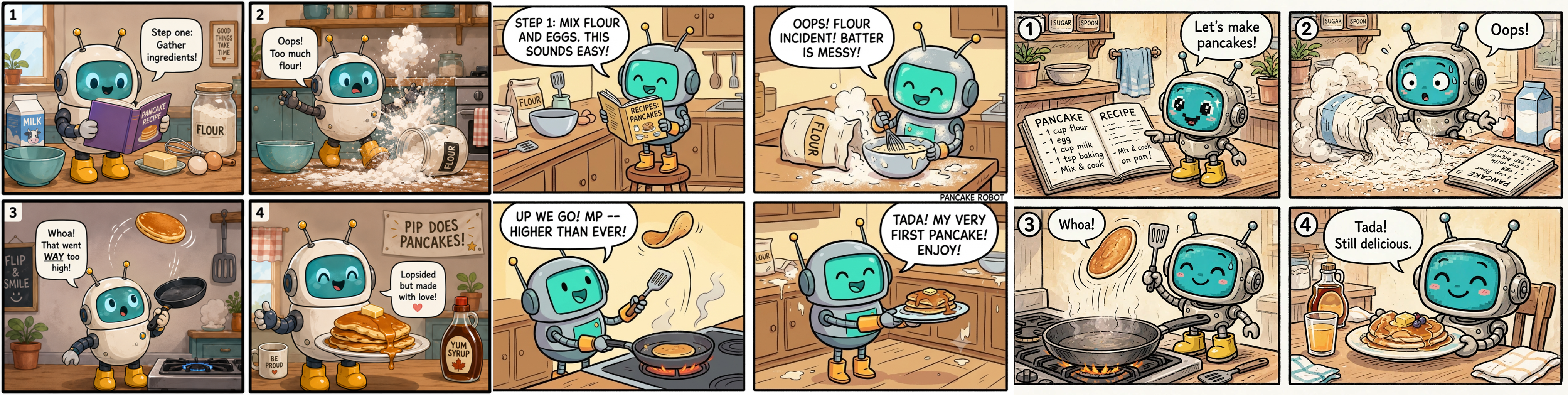
The fourth prompt asked for a four-panel comic strip about a cheerful robot named Pip baking pancakes, while keeping Pip consistent across all panels. It also tested sequential storytelling. This was one of the strongest rounds for all three models.
ChatGPT's comic was easy to follow and was also the most amusing. Gemini had the cleanest cartoon polish. Meta did a great job in most ways, but gave the pancake a word balloon for some reason.
Noir cartoonA noir cartoon by ChatGPT (left), Gemini (middle), and Meta (right) — click the image to open a full-size version (Image credit: ChatGPT, Gemini, Meta)
Finally, I asked each model to combine a noir setting with a Saturday morning cartoon. Specifically, a private detective investigating a mysterious missing cookie inside a 1940s suburban kitchen in black-and-white. The prompt tested style-blending, whether the models could make the scene feel like both a detective story and a cartoon.
ChatGPT did a good job balancing the noir mood with a cartoon detective with a dog sidekick. Gemini went for more of a classic detective drama intensity. Meta was the most comedic, with a canine detective exploring scattered clues amid plenty of visual jokes. Meta definitely did the best job in hitting both sides of the prompt.
ChatGPT told the story cleanly, and Gemini had the strongest noir atmosphere, but Meta made the prompt feel the most alive. It understood that a missing cookie mystery should be dramatic and ridiculous.
Five prompts turned out to be enough to show that these image generators have each developed their own personalities. Nano Banana 2 consistently impressed with realism. Meta AI took bigger creative swings than I expected, producing the funniest image of the test in the cookie detective challenge and some of the most polished commercial-looking visuals.
But ChatGPT stood out for seeming to understand what I was actually trying to achieve more consistently than its rivals. It repeatedly delivered images that matched both the wording and the intent of the prompt. The only category where I thought it was genuinely beaten was the film noir cookie mystery, where Meta more effectively embraced the ridiculous premise.
All three are capable of producing good results; the difference comes down to judgment. The best model is the one that understands what you meant. ChatGPT proved to be the strongest at making that leap, even if Meta sometimes stole the show.
Categories: Technology
Why your security stack might be guarding the wrong door
Whether it’s a new agent, a new gateway, or a new monitoring layer, every time a security gap appears, the instinct is to close it with a new tool. It seems sensible in the short term, but over the years, the layers build up until enterprise security becomes one of the most complex and costly parts of running a business.
The result is a fragmented stack that is expensive to license, difficult to manage, and hard to justify to the board. Security teams are left with overlapping controls, integration headaches, and a user experience rife with friction. And to make matters worse, the whole bloated stack might well be pointed in the wrong direction.
Work moved, but security didn'tFor most knowledge workers, the browser is where the working day begins and ends. From CRM to email, a growing number of enterprise applications are best delivered through a browser tab. Adding to this is the rapid adoption of generative AI tools, which employees use daily for drafting, analysis, and workflow automation. The browser is not a gateway to work but has become the workspace itself.
Security architecture has not kept pace with this shift. The controls most organizations rely on were designed for a different era, one built around corporate networks, managed devices, and applications behind a firewall. That model has not existed in its original form for years, yet it still underpins traditional security strategies.
As a result, there is a significant blind spot: Network and device-level controls can determine whether a user is allowed to reach an application, but they cannot see what happens once they are inside it.
When the stack stops at the door, critical information never crosses the threshold. For example, organizations may never see data is being accessed, how it is being handled, and whether it is copied into a personal email or pasted into a public AI tool.
The browser is the primary attack surfaceMost workers use consumer browsers designed for the broadest audience possible. Because they’re not built for the rigors and needs of enterprise use, they’re soft targets.
Savvy threat actors can harvest credentials inside the browser session, and malware targets locally stored cookies and passwords. Data exfiltration increasingly happens not through network breaches but through routine user actions such as copying a customer record, downloading a report, or sharing a file with the wrong destination.
The rapid rise of AI tools has exacerbated the problem. Employees are pasting sensitive business data into generative AI platforms without understanding where it goes or how it is retained. Agentic tools that take actions inside business systems on a user's behalf are especially risky. They introduce a category of risk that most security teams have limited visibility into, and those interactions leave no trace on the network perimeter.
Legacy security tools were not built to see inside a browsing session. They inspect traffic, scan endpoints, and flag anomalies after the fact. By the time a control triggers, the action has often already happened.
Control needs to move to where decisions are madeWith enterprise activity concentrating in the browser, the enforcement layer needs to follow suit.
The most important thing to reframe is moving from managing access to managing behavior. Traditional security tends to focus on whether a user is permitted to access an application.
That still matters, but the more consequential question is what happens inside the application once access is granted. A file downloaded to a personal device or a customer record pasted to a private email are the moments when data movement can turn into data loss risk. But most security and data protection stacks can’t see them.
Embedding security and data protection into the browser makes these moments governable because policy applies at the point of action, in real time, without disrupting the workflow. A user working with sensitive data can move it freely between authorized applications, while controls prevent it from reaching an unauthorized destination.
This is also where zero trust can be properly realized. Most implementations evaluate identity and device posture once, at login. A browser-native model assesses session context continuously, adjusting controls as circumstances change without interrupting the user. Enforcement follows the work, rather than waiting at the edge of the network.
Consolidation is the only way forwardManaging browser risk isn’t simply a case of throwing more tools into the stack. Many enterprises will find their stack is already full of layers that were built to compensate for consumer browsers. You have a virtual desktop interface (VDI) to control application access, and VPNs maintain network tunnels for SaaS tools that need a very different method of connectivity and protection.
Data loss prevention (DLP) solutions attempt to intercept data movement after the moment it happens, and cloud access security broker (CASB) layers mediate cloud access that the browser already intermediates.
Each is a reasonable response to a security gap, but together they establish an unwieldy infrastructure that was never designed to work as a whole. These systems force 100% of data through choke points (SASE cloud proxies) for inspection, creating performance bottlenecks and a poor user experience.
And as encryption cyphers strengthen toward post-quantum encryption standards, a significant portion of this traffic is blind to these break and inspect architectures.
Closing them from the inside by making the browser itself the primary point of governance removes the need for many of them entirely. The stack got this big by solving the wrong problem, and solving the right one starts with the browser.
We've featured the best endpoint protection software.
This article was produced as part of TechRadar Pro Perspectives, our channel to feature the best and brightest minds in the technology industry today.
The views expressed here are those of the author and are not necessarily those of TechRadarPro or Future plc. If you are interested in contributing find out more here: https://www.techradar.com/pro/perspectives-how-to-submit
Categories: Technology
Can't find a fan? Don't panic — as a home tech expert, I've tracked down 7 premium models that are still in stock from Dyson, Shark, and Meaco for delivery this week
Need a fan to help you handle the ongoing heatwave, but found yourself facing empty shelves? Don't panic — there's still time to grab a great one, if you know where to look. I'm TechRadar's home tech expert, and I've scoured the web to find the fans that I'd buy with my own money, and which are still in stock for delivery this week.
First of all we have the Shark ChillPill, which I currently have in my bag, and is a lifesaver on public transport — or even if you're outside when the wind dies down and you're feeling uncomfortable. The fun colours are sold out, but it's still available in silver and grey. There's a Dyson Pure Hot+Cool HP00 still available to buy as well, and it will double as a heater when winter rolls around.
Dimplex's FlexBlade fan is still available, and blows a sheet of air over your bed. I used this fan when the temperature hit 35C and it was the only way I could get a proper night's sleep. I have a Meaco Sefte fan on my desk, and although Meaco's own storefront has been stripped bare, you can still grab its six-inch diameter air circulator at John Lewis if you're speedy. Read on for links to all these fans and more, but move fast — they won't be around for long.
Big-name fans still in stock Shark ChillPill 3-In-1 Personal Fan Travel Bundle - Cloud Dimplex FlexBlade Multi-Directional Bladeless Fan Meaco Sefte 6" Desk Fan, White Charcoal Dimplex DuoCool Smart Wi-Fi Cordless 2-in-1 Fan DYSON Pure Hot+Cool HP00 Purifying Fan Heater SHARK ChillPill 3-in-1 Personal Fan - Carbon SWITCHBOT Battery Circulator Fan
Categories: Technology
The hidden cybersecurity risk sitting in every SMB office
For many small and medium-sized businesses, cybersecurity conversations center on endpoints like laptops, servers and cloud platforms.
Yet one category of device continues to sit quietly outside that focus: the printer.
Despite being deeply embedded in day-to-day operations and handling highly sensitive information, print infrastructure is still widely overlooked.
This lack of scrutiny is part of a broader challenge. New research shows 73% of UK SMBs fear data privacy issues in their current document management processes, highlighting widespread concern about how sensitive information is handled across both digital and physical workflows.
Yet 55% of UK SMBs consider printers a low priority in their cybersecurity strategy.
This worrying disconnect between the critical data printers handle and their low security prioritization creates a vulnerability that attackers can exploit to access sensitive workflows, intercept documents or move laterally within a network.
A growing blind spot in hybrid working environmentsAs we know, work no longer sits neatly inside the office. It happens across home networks, personal devices and shared spaces – environments that SMBs struggle to monitor or control. Today, print and scan workflows routinely handle sensitive data, from payroll and contracts to customer records.
Without visibility into who is printing what and where, organizations have no way of protecting that sensitive data. And it doesn’t take much – just one misdirected scan or a print job left in a tray can expose confidential information, often without any obvious sign that something is wrong.
According to Quocirca, 74% of SMBs have experienced a print-related data loss incident in the past year. A further 33% say documents printed on employee-owned home printers are now a top factor in data loss.
Behavioral factors further amplify the problem. Research shows 47% of UK SMBs believe that employees try to bypass their organization's print security guidelines. At the same time, 63% assume their printers are secure because they sit behind a firewall, and half do not consider them a security threat at all.
Together, these trends point to a clear security gap: while print workflows are handling increasingly sensitive data across distributed environments, they are not being secured, monitored or governed to the same standard as other endpoints.
Real risk in outdated hardwareAlmost three-quarters (73%) of UK SMBs frequently worry about the risk posed by their outdated systems. Older printers running unpatched firmware and default credentials quietly process and store sensitive data while remaining unmanaged.
A compromised printer can serve as an entry point into wider business systems. If laptops and servers require active monitoring, printers do too.
Concerns are not limited to hardware. They also span cybersecurity exposures linked to connected printers, vulnerabilities introduced as scanned documents move through the cloud, and the risk of unauthorized access to print queues.
Alongside this are more visible, day-to-day issues, such as confidential documents being left unattended and the difficulty of tracking information once it exists in physical form.
These risks can be managed, but only if SMBs treat print and scan as part of the security perimeter.
Without this, resilience across hybrid workflows becomes guesswork. The future of work is not only about cloud and AI; it is also about securing the everyday document processes that move sensitive data across physical and digital environments.
Building control through visibility and smarter printingDespite low prioritization, almost six-in-ten (63%) SMBs in the UK acknowledge print security needs improvement. To secure the future of work, organizations need secure print hardware foundations and protection that keeps pace with evolving threats.
Smart printing builds on these secure hardware foundations by embedding visibility, policy enforcement and audit trails directly into print and scan workflows.
Of UK SMBs that have adopted smart printing, 89% say it provides clearer visibility into printing and scanning activity across users and locations, 86% say it helps them meet compliance and security standards, and 85% say it improves enforcement of rules and restrictions.
Rethinking the role of print in cybersecurityAs we delve deeper into the future of work, printers need to be brought into the wider security strategy. A data breach originating from a printer can be just as damaging as one involving a compromised device or network, with the potential for significant financial loss, regulatory penalties and reputational harm.
Printers are not just office equipment. They are part of the digital infrastructure that supports modern work. As print and scan workflows become more digital and cloud-connected, printers deserve the same security attention as any other endpoint.
In practice, that means SMBs need three things: secure hardware as a foundation, security that keeps pace with new threats, and the visibility and control to maintain resilience at scale. Bringing printers into the security strategy is a practical step towards protecting sensitive data in a world where both work and risk are distributed.
We've reviewed and rated the best all-in-one printers.
This article was produced as part of TechRadar Pro Perspectives, our channel to feature the best and brightest minds in the technology industry today.
The views expressed here are those of the author and are not necessarily those of TechRadarPro or Future plc. If you are interested in contributing find out more here: https://www.techradar.com/pro/perspectives-how-to-submit
Categories: Technology
Duck.ai by DuckDuckGo review
Duck.ai is one of the only AI chat platforms where you can hold a conversation with GPT-5 or Claude Opus without registering an account. Launched by DuckDuckGo in early 2025, it sits inside the company's existing search and browser ecosystem. You can access it at duck.ai, through the DuckDuckGo browser, or via desktop browser extensions.
Two things set it apart from other AI chat tools. Every conversation goes through DuckDuckGo's anonymizing proxy before reaching the model provider, stripping out identifying information. Providers such as OpenAI and Anthropic are also contractually prohibited from using those chats for training purposes, which is a meaningful commitment that most direct-to-model platforms don't offer.
At TechRadar Pro, we've been reviewing business software since 2012. Our AI coverage includes an AI tools roundup and a 2026 vibe coding buying guide, among other platform reviews and news features.
What is Duck.ai?Duck.ai is DuckDuckGo's AI chat service, designed so that you can talk to leading AI models without creating an account or sharing personal data. It's available at duck.ai, through DuckDuckGo's browser extensions, and inside the DuckDuckGo app on iOS and Android.
The service routes all conversations through a privacy proxy. Your prompts are anonymized before they reach the AI provider. DuckDuckGo also holds providers to strict contractual limits on data use, meaning chats are not stored on DuckDuckGo's servers and cannot be used for model training by either party.
It works for typical AI tasks: drafting emails, summarizing documents, answering questions, writing code, and general chat. Privacy-conscious professionals, freelancers, and anyone who wants frontier AI access without a recurring account will find it useful.
Duck.ai: At a glanceAttribute
Notes
Underlying model(s)
Free: Claude 4.5 Haiku, GPT-4o mini, GPT-5 mini, gpt-oss-120b, Llama 4 Scout, Mistral Small 3 24B. Plus: GPT-4o, GPT-5.4, Claude Sonnet 4.6, Llama 4 Maverick. Pro: adds Claude Opus 4.7.
Best for
Privacy-conscious users; general AI chat tasks; no-signup AI access
Distinguishing functions
Privacy proxy routing, no-login access, multi-model switching, voice chat
UI features
Minimal chat interface with left sidebar for model switching; chat history stored locally on device
Subscription costs
Free; Plus: $9.99/month or $99.99/year; Pro: $19.99/month or $199.99/year
API pricing
No public API — consumer product only
Buy it if…- You want AI chat without an account. Duck.ai is one of few platforms giving you access to capable models, including GPT-5 mini, without registration or a credit card.
- Privacy matters to your workflow. DuckDuckGo anonymizes every chat through its proxy and holds AI providers to strict data-use agreements, making it a stronger privacy choice than signing up directly with OpenAI or Anthropic.
- You want multi-model value. The Plus plan at $9.99/month pairs GPT-5.4 and Claude Sonnet 4.6 with a full VPN and identity protection, making it genuinely competitive.
- You need a developer API. Duck.ai has no API. If you're building products or automations on top of AI models, go directly to OpenAI or Anthropic.
- You already have a VPN. The paid plans bundle AI with VPN and identity services. There's no AI-only subscription tier, so you may end up paying for things you don't need.
- You depend on predictable limits. DuckDuckGo doesn't publish exact daily message limits, which makes it difficult to plan for high-volume or time-sensitive work.
I tested Duck.ai across the free and Pro tiers over several weeks. On the free tier, the experience is clean and fast with no friction, no sign-up, and six models ready to go. Switching between GPT-4o mini and Claude 4.5 Haiku is a single click. Both handled research queries and writing tasks without issue.
The Pro tier adds Claude Opus 4.7 with extended reasoning. The improvement shows on complex tasks: I ran the same multi-step analytical prompt across the free and Pro tiers. Opus 4.7 returned a more structured and well-reasoned response. For everyday writing or quick lookups, the free tier is more than enough. Pro earns its keep on specialist, multi-step work.
My one persistent frustration was the opacity around usage limits. DuckDuckGo's policy is to keep limits vague to prevent abuse. During testing I didn't hit a ceiling on Pro, but I can imagine high-volume users running into walls without much warning.
Duck.ai: FeaturesThe defining feature is the privacy proxy. Every message goes through DuckDuckGo before reaching the AI provider. The company holds providers to contractual restrictions on data use, which matters most if you're typing sensitive information into an AI: prompts about financial decisions, health issues, or confidential business matters are much less exposed than they would be via a direct provider account.
The free tier's model roster is unusually strong for a no-login service. Alongside GPT-4o mini and Claude 4.5 Haiku, you also get GPT-5 mini and OpenAI's gpt-oss-120b, both capable models that would cost real money through direct API access. Meta's Llama 4 Scout and Mistral Small 3 24B round out the lineup for users who prefer open-weight options.
Paid subscribers get meaningfully stronger models. The Plus plan adds GPT-5.4 and Claude Sonnet 4.6, which excel at long-context tasks and following detailed instructions. The Pro plan goes further with Claude Opus 4.7 and extended reasoning, suited to the kind of multi-step analysis that trips up smaller models.
Voice chat, launched in February 2026, lets you speak to an AI model through an encrypted relay connection. Audio is not stored by DuckDuckGo or OpenAI after the session ends, keeping the privacy principles consistent. The feature currently uses OpenAI as the model provider, so model choice for voice is limited.
File uploads are not yet supported, which is a gap compared to ChatGPT or Claude.ai. If you need to analyze a PDF or document, you'll need to paste content manually. DuckDuckGo has indicated uploads are on the roadmap.
Duck.ai: User experienceThe interface is intentionally minimal. There's no dashboard, no settings maze, and no onboarding flow. The left sidebar shows your chat history, stored locally on your device rather than on DuckDuckGo's servers. You switch models by clicking the current model name at the top of the conversation. New users can start a chat in seconds.
AI features are also fully optional. DuckDuckGo lets you hide Duck.ai buttons and AI overlays in search settings, which is a meaningful gesture from a company that treats privacy as more than a marketing position. The option to disable AI without losing other features is something many platforms don't offer.
Duck.ai: Customer supportDuckDuckGo maintains detailed help documentation at its Help Pages site, covering Duck.ai's privacy policies, model availability, usage limits, and subscription management. The documentation is well-organized and answers most common questions without requiring you to contact anyone.
There's no live chat or phone support channel. For subscription or billing issues, you can reach support through the subscription settings menu, but response times aren't publicized. Businesses planning to rely on the Pro plan for critical work should factor this in when evaluating the service.
(Image credit: DuckDuckGo)Duck.ai: Pricing- Free: Six models, no sign-up, with unspecified daily usage limits.
- Plus: $9.99/month or $99.99/year, which adds GPT-4o, GPT-5.4, Claude Sonnet 4.6, and Llama 4 Maverick, plus VPN, Personal Information Removal, and Identity Theft Restoration.
- Pro: $19.99/month or $199.99/year, which adds Claude Opus 4.7, extended reasoning, and 2x usage limits versus Plus.
The free tier is one of the best no-login AI offers available right now. Getting GPT-5 mini and Claude 4.5 Haiku at zero cost, with genuine privacy protections, is a hard proposition to dismiss. The Plus plan at $9.99/month undercuts both ChatGPT Plus and Claude Pro (each $20/month) while providing access to frontier models alongside a bundled VPN.
The Pro plan at $19.99/month is harder to recommend to most users. Claude Opus 4.7 with extended reasoning is a premium experience, but only for tasks that genuinely require deep multi-step analysis. There's no standalone AI-only option, so if you already pay for a VPN elsewhere, you're likely paying twice. The subscription is available internationally with localized pricing: UK users pay £9.99/£19.99 per month for Plus/Pro respectively, and most EU countries are priced at EUR 9.99/19.99 per month.
Duck.ai: Alternatives you should consider- ChatGPT: OpenAI's direct interface costs $20/month for Plus and offers GPT-4o access alongside file uploads and image generation, two features Duck.ai currently lacks. The downside is that ChatGPT requires an account and uses conversation data for service improvements unless you opt out.
- Claude.ai: Anthropic's own interface gives you Claude Opus at $20/month on the Pro plan and is stronger for deep reasoning work. It requires registration, doesn't offer multi-model switching, and has weaker privacy protections than Duck.ai's proxy approach.
- Perplexity AI: A strong alternative if you want AI answers grounded in real-time web search. Perplexity Pro costs $20/month and supports file uploads, though it doesn't match Duck.ai on privacy routing.
- Ran identical prompts covering research queries, email drafting, and complex analytical tasks across the free, Plus, and Pro model tiers to compare quality and speed.
- Reviewed DuckDuckGo's published privacy documentation, provider contracts policy, and help pages to assess how well its privacy proxy claims hold up.
- Tested the subscription sign-up, model switching, voice chat, and local history access on both desktop and mobile across several sessions.
Response latency on the free tier is slightly higher than a direct ChatGPT session, consistent with traffic being routed through a proxy. The difference was small enough that it wasn't noticeable mid-conversation. Pro-tier responses were fast regardless of model choice, with Claude Opus 4.7 taking marginally longer on extended reasoning tasks — which is expected given the additional processing involved.
Categories: Technology
Lidl customers across Europe hit in suspected data breach - here's what we know
- Lidl confirms cyberattack at third-party IT service provider that exposed customer data including names, phone numbers, emails, dates of birth, and customer numbers
- Passwords, payment details, and addresses were not affected, but the company warns of phishing risks and urges vigilance against identity fraud attempts
- Incident was contained quickly, reported to authorities, and investigated by forensic experts; Lidl operates ~12,900 stores across 32 countries
Lidl is warning its customers of a cyberattack which may have affected some of their personal information stored with the company.
In a data breach notification published on its Netherlands, Belgium, and Germany websites, the German discount supermarket chain said an IT security incident at one of its IT service providers affected some of the data stored by Lidl Online Shop customers.
“We were informed of this incident at the beginning of the week,” a machine-translated notification reads. “Despite high IT security standards, unknown persons briefly gained access to a separately stored file with customer data and part of the data was stolen from it. The system of the online shop itself is not affected.”
Unknown impactLidl said that the unnamed miscreants walked away with people’s full names, phone numbers, email addresses, dates of birth, and customer numbers. Passwords, billing and delivery addresses, bank details, and other payment information, was allegedly not stolen. Customer accounts remained unaffected, as well.
However, the company is urging its customers to remain vigilant, since there is a high chance the crooks will use the data to send personalized phishing emails.
“Although we currently have no concrete evidence of misuse of data, we warn you about possible phishing attempts or identity fraud as a precaution,” Lidl said.
The company did not say which IT service provider was targeted, or how many people are affected. It merely stated that the company “responded immediately” and “took necessary steps” to restore the full security of the affected systems. The company also filed a report with the relevant authorities, and called in IT forensic experts to investigate the incident.
Local authorities, such as the Dutch Data Protection Authority, or the Belgian “competent supervisory authority for data protection” were notified, as well.
Lidl operates around 12,900 stores across 32 countries in Europe and the United States.
Via Cybernews
Categories: Technology
Why AI infrastructure costs keep surprising IT leaders
IDC projects that AI infrastructure costs at Global 1000 companies will run 30% higher than current budgets by 2027. That gap shows a mismatch between how AI workloads behave in production and how enterprise IT has historically planned for capacity.
The pattern repeats across industries. A pilot project validates an AI model on a controlled dataset, and budgets are created around those economics. When the system moves into production, the bill often outpaces what anyone originally modeled.
The natural instinct is to blame the size of the model or the cost of using tokens, but that’s not where the money goes. The cost lives in the data layer, driven by how often the system reads, how many services it touches, and how continuously those operations run.
What pilots don’t show youA pilot runs against a narrow dataset, with a handful of concurrent users, on a request-response cadence familiar to anyone who has shipped a web application. Production looks nothing like that.
Consider a generative AI customer support agent in production. A single user prompt can trigger simultaneous lookups across session activity, CRM records, inventory systems, retrieved manuals, and other sources before the model produces a response. All of this happens under sub-100ms latency budgets, with the slowest lookup gating the rest. The operational problem becomes tail latency across many small parallel lookups.
Now layer agentic workflows on top. A user request decomposes into a plan, then into a series of steps that each issue their own lookups, write intermediate state, and read it back. What starts as one inference expands into tens or hundreds of data accesses, with the system holding session and memory state across the entire arc. The cost profile that emerges is nothing like what the pilot priced.
Where the 30% comes fromThe overrun comes from a series of defensive choices made under uncertainty. When teams can’t see how data flows through a single request, they over-provision to absorb spikes. When they can’t predict cache behavior under shifting context, they duplicate data across systems to reduce dependency risk.
When one downstream service slows down, they layer another service on top to insulate against it. Each choice is locally rational. The aggregate is a system that costs 30% more than the workload requires, and that’s before anyone adds a new use case.
The underlying problems are usually the same. Fan-out per request goes unmeasured end-to-end. Context gets fragmented across feature stores, session stores, user profile systems, vector indexes, and third-party APIs. KV cache and prefix reuse get left on the table because the inference layer can’t hold or share state across calls.
Replication and tiering decisions get made per system rather than per access pattern. None of these show up in a pilot. All of them show up in the production bill.
What the AI data tier has to deliverAI in production is a continuous, distributed system whose hot path is context assembly — many small reads per request under tight latency budgets — combined with writes that must keep multiple representations of the same entity consistent.
These systems need two things at the same time: predictable low-latency reads under high concurrency and consistent writes across the data path. The infrastructure underneath has to be sized and shaped accordingly.
A few architectural decisions end up driving most of the outcome:
Match the data tier to the access pattern Session state, agent memory, feature lookups, retrieved context, and KV cache reuse all have different read patterns, freshness requirements, and durability needs.
Treating them as different data tiers — or laying them on whatever database happens to be in the stack — is the most common source of overrun. The session store and the system of record have different access pattern demands from the same data tier.
Engineer for fan-out and predictable tail latency Throughput is the wrong primary metric for an AI data tier. The right one is the predictability of many small reads triggered by one request. A batch of parallel lookups is only as fast as its slowest member, and a single slow lookup stalls the entire context-assembly step.
Storage systems optimized for write throughput pay a read amplification penalty under this access pattern. Systems that keep the primary index in memory and resolve point lookups in a single I/O behave differently at the tail.
Treat write consistency as a correctness requirement When updates across user profiles, embeddings, feature vectors, and session state aren’t synchronized, downstream context assembly reads a mix of versions and the model produces confident output grounded in contradictory data.
These are hallucinations that have nothing to do with sampling or model probability, and they don’t yield to better prompts or bigger models.
Treat inference-time data reuse as infrastructure. KV cache reuse, prefix sharing, and agent memory persistence are first-class infrastructure concerns. Teams that figure this out early run the same workloads at lower GPU utilization than teams that haven’t. This is the largest leverage point that doesn’t appear in most AI cost models.
Where to startThe most useful first step is to trace a single production request end-to-end — counting lookups, logging sources, and measuring tail latencies. That exercise reveals more than any architectural review. Once teams can see how data moves through one interaction, they can categorize data accesses by tier and verify that each is running on infrastructure suited to its pattern.
From there, the next question is what’s being recomputed that could be reused, particularly across inference calls and agentic steps. Fan-out per interaction should become a metric teams watch as closely as p99 latency — because at scale, it drives cost just as directly.
AI cost in production is a design discipline. Teams that address it early have far more control over performance and spend than teams that wait until the bill forces the issue. In many cases, the 30% gap is the cost of learning these lessons too late.
We've featured the best AI tool.
This article was produced as part of TechRadar Pro Perspectives, our channel to feature the best and brightest minds in the technology industry today.
The views expressed here are those of the author and are not necessarily those of TechRadarPro or Future plc. If you are interested in contributing find out more here: https://www.techradar.com/pro/perspectives-how-to-submit
Categories: Technology
I Took a Vision Test in 90 Seconds With a Robot and Saw the Future of Vision Care
Eyebot wants to make getting a prescription for glasses as fast as ordering a coffee.
Categories: Technology
DeepSeek AI review
DeepSeek landed like a thunderclap in January 2025, when its R1 reasoning model briefly dethroned ChatGPT as the most downloaded free app on the iOS App Store in the United States. Built by a Hangzhou-based AI lab backed by Chinese hedge fund High-Flyer, it claimed to match frontier AI performance at a fraction of the development cost. That claim sent Nvidia's stock tumbling 17% in a single session and sparked a global conversation about who was actually winning the AI race.
Since then, DeepSeek has grown to roughly 97 million monthly active users and released multiple model generations, most recently the V4 family in April 2026. Its API pricing stands out: the V4 Flash model starts at $0.14 per million input tokens, cheaper than most "lite" tier models from OpenAI and Google yet competitive on coding, math, and reasoning benchmarks. The open-weight licensing under MIT also means teams can self-host the models and sidestep per-token costs entirely at scale.
We've been reviewing B2B software at TechRadar Pro since 2012, with AI platforms among our most active coverage areas in recent years. Our AI tools roundup, vibe coding guide for 2026, and explainers on OpenClaw and Moltbook give you a sense of the tools we track. DeepSeek is one of the more polarizing platforms we've tested: impressive in many ways, but not without significant red flags.
What is DeepSeek?DeepSeek is an AI chat platform and API service developed by Hangzhou DeepSeek Artificial Intelligence Co., Ltd., a Chinese company founded in 2023 and funded by the quant hedge fund High-Flyer. It offers a free web and mobile chat interface at chat.deepseek.com alongside a paid developer API, both powered by the same underlying model family.
The platform runs on DeepSeek's own large language models, specifically V4 Flash and V4 Pro, both using a Mixture-of-Experts (MoE) architecture. Only a subset of each model's parameters activates per token, which keeps inference costs low without shrinking the model's overall knowledge base.
V4 Pro has 1.6 trillion total parameters but only 49 billion active at inference. V4 Flash runs 284 billion total with 13 billion active, making it significantly faster and cheaper without sacrificing much on everyday tasks.
Developers, researchers, and cost-conscious businesses are the natural audience. The free chat tier suits individuals and small teams exploring the tool, while the API's aggressive pricing makes it attractive for anyone building AI-powered applications at scale.
DeepSeek: At a glanceAttribute
Notes
Underlying model(s)
DeepSeek V4 Flash (284B total / 13B active params) and V4 Pro (1.6T total / 49B active params), both MoE-based
Best for
Coding assistance, mathematical reasoning, document analysis, budget API use
Distinguishing functions
1M token context, thinking/non-thinking modes, prompt caching, open weights (MIT)
UI features
Web chat and iOS/Android apps with web search toggle, file upload (PDF, DOCX, TXT), Expert Mode and Instant Mode
Subscription costs
Free (chat app, unlimited queries); no paid chat subscription tiers
API pricing
Pay-per-token; new accounts receive 5M free tokens valid 30 days; V4 Flash at $0.14 / $0.28 per 1M tokens (input/output); V4 Pro at $1.74 / $3.48 standard, with promotional discounts available
Buy it if…- You need a cheap, capable coding or reasoning API. V4 Flash at $0.14 per million input tokens is among the most affordable frontier-adjacent APIs available, and its benchmark results on coding and math hold up well against more expensive competitors.
- You want open weights for self-hosted deployment. Both V4 models are released under MIT license on Hugging Face, giving teams the option to run the model on their own infrastructure and eliminate per-token costs entirely for high-volume workloads.
- You're doing non-sensitive exploratory work. For individual researchers, students, or developers prototyping non-confidential projects, the free chat app offers web search, file uploads, and a 1M token context window at zero cost.
- Your work involves confidential or regulated data. All user data is stored on servers in mainland China, subject to Chinese law, which permits government access without user consent. Multiple governments have banned DeepSeek from official devices for exactly this reason.
- You need consistent responses on sensitive topics. DeepSeek avoids certain politically sensitive subjects, particularly around Chinese domestic affairs. That content filtering can produce evasive or incomplete outputs on topics that other platforms handle straightforwardly.
- You're in a GDPR-regulated region. Italy's data protection authority blocked DeepSeek outright in January 2025 after the company provided what regulators called a "completely insufficient" response to data practice inquiries.
I tested DeepSeek's chat app and API across a range of tasks: code generation, document summarization, long-form reasoning, and general Q&A. On raw capability, the V4 models impressed me. Code outputs were clean and well-structured, long document summaries were accurate, and the one-million-token context window handled full-length PDF ingestion without complaint.
The thinking mode, accessible via Expert Mode in the chat UI, added visible chain-of-thought reasoning that proved useful for multi-step problems rather than theatrical.
What gave me pause was everything outside the model itself. Certain politically sensitive prompts returned conspicuously vague or deflective answers — the kind of behavior that wouldn't be acceptable in a professional context where consistent and complete information matters. I also found that the chat interface lacks the memory and personalization features you'd find in ChatGPT or Claude.
Value for money on the API side is difficult to argue with. A production app with well-structured prompts benefits substantially from the caching discount: cached input tokens cost just $0.014 per million for V4 Flash, a 90% reduction. For high-volume, low-sensitivity workloads, that arithmetic is compelling.
DeepSeek: FeaturesDeepSeek's core chat feature set covers the bases you'd expect: text generation, code writing and debugging, document summarization, mathematical reasoning, and web search. The web search integration is a manual toggle rather than always-on, which keeps responses faster by default but requires you to switch it on when real-time information matters. File uploads support PDF, DOCX, and TXT formats, with the model able to summarize and answer questions based on the uploaded content.
The standout capability is the 1M token context window introduced with V4, up from 128K in the previous generation. That's a meaningful jump for anyone analyzing long contracts, codebases, or research documents in a single session. Most competitors at comparable price points max out at 128K to 200K tokens.
V4 Flash covers both thinking and non-thinking modes, so you don't need to switch between separate models depending on task complexity. Non-thinking handles fast general responses; thinking adds structured multi-step reasoning for harder problems. That flexibility matters more than it sounds when you're toggling between casual tasks and complex analysis in the same workflow.
Where DeepSeek falls short is multimodal support. The platform does not currently support image generation or image understanding in the web app, putting it behind ChatGPT, Claude, and Gemini on that front. Agentic capabilities are available in the V4 Preview but remain early-stage compared to dedicated agentic platforms.
DeepSeek: User experienceThe chat interface at chat.deepseek.com is straightforward and fast to get started with. Signing up requires only an email address from a global provider like Gmail or Yahoo, and the default experience drops you straight into a conversation window. The distinction between Expert Mode (thinking-enabled, slower) and Instant Mode (faster, non-thinking) is surfaced clearly at the top of the interface, and mobile apps on iOS and Android mirror the web experience with file upload and web search included.
The learning curve is shallow for casual use. Switching between thinking and non-thinking modes takes one click, and the file upload workflow is drag-and-drop simple.
The API experience is less forgiving for first-time integrators. Unlike the chat app, the API is stateless, meaning every call must include the full conversation history in the messages array. DeepSeek's documentation covers this clearly, but it catches developers accustomed to managed conversation state elsewhere off guard.
DeepSeek: Customer supportSupport options for free chat users are limited to a Discord community server and an email channel for API service inquiries (api-service@deepseek.com). Community responses on Discord can be prompt, but they depend on other users rather than official staff. There is no live chat or phone support.
API customers have slightly more recourse through direct email support, though response times vary. The official documentation at api-docs.deepseek.com is thorough and well-organized, covering model details, pricing, rate limits, and code examples in both Python and curl. For developers comfortable with self-service documentation, it's adequate.
(Image credit: DeepSeek)DeepSeek: Pricing- Chat app is free with no query limits. The web and mobile apps give you unlimited access to V4 Flash and V4 Pro at no cost, including web search, file uploads, and the full context window.
- New API accounts receive 5M free tokens, valid for 30 days, giving developers a zero-cost window to prototype and test.
- API billing is pay-as-you-go. V4 Flash costs $0.14 per million input tokens and $0.28 per million output tokens. V4 Pro runs $1.74 and $3.48 respectively at standard rates, with promotional discounts periodically dropping those to $0.435 and $0.87. Cached input tokens cost one-tenth of the standard input rate on both models.
The free chat tier is generous by any measure. Unlimited queries with a 1M context window puts it ahead of most free-tier competitors in raw access terms, and there's no paid chat subscription to worry about. Power users who need more control either stick with the free app or pay per token via the API.
On the API side, DeepSeek makes a strong case for developers managing costs at scale. Off-peak pricing discounts of up to 75% are available during 16:30–00:30 UTC, giving teams with flexible scheduling another cost lever. For production apps with well-structured prompts sharing a common system context, effective input costs can drop well below $0.02 per million tokens with caching applied.
DeepSeek: alternatives you should consider- ChatGPT (OpenAI): The most capable all-around AI platform, with image understanding, voice, and memory. API pricing is higher, but US-based data residency and enterprise data agreements make it a safer choice for sensitive business workloads.
- Claude (Anthropic): Particularly strong for long-form writing and document analysis, with comparable context windows and clearer data handling policies. Claude Pro starts at $20/month for individual users.
- Gemini (Google): Tightly integrated with Google Workspace and built for multimodal work across text, image, and video. Gemini 2.5 Flash offers competitive API pricing with no Chinese data jurisdiction concerns.
- Used the free web app for code generation, document summarization, mathematical reasoning, multi-turn Q&A, and file analysis, covering both Instant Mode and Expert Mode across each task type.
- Ran API calls across varying prompt sizes to verify context window behavior, caching discounts, and response consistency, following DeepSeek's own temperature guidance for different task types.
- Cross-referenced DeepSeek's official privacy policy, third-party security research from NowSecure and SecurityScorecard, and regulatory actions from Italy, Australia, South Korea, and US government bodies to build a complete picture of the data risk profile.
Beyond hands-on testing, I reviewed DeepSeek's official API documentation, the V4 technical report published on Hugging Face, and benchmark data from the April 2026 release. Pricing figures were sourced directly from the official DeepSeek API documentation and corroborated against third-party tracking services.
Categories: Technology
Microsoft admits its carbon emissions grew 25 percent in 2025, including a rise in fossil fuel use
- Microsoft produced 20.3 million tons of CO2e emissions last year, up from 16.2 million tons
- Of the 37.5 million MWh of energy used, only 422,000 MWh came from unsustainable sources
- A rise in diesel/crude oil consumption and Scope 2 emissions are key drivers
In its latest sustainability report, Microsoft has admitted its greenhouse gas emissions actually rose 25.1% year-over-year from 16.2 million tons to 20.3 million tons in 2025.
With the company targeting a 2030 carbon negative deadline, rising emissions presents a major challenge that it must overcome, however current trends point to emissions continue to rise even further.
Microsoft said its rapid expansion of AI and cloud data centers as a key driver for rising emissions, and with more projects in the pipeline, this could be an ongoing challenge for years to come.
Microsoft's emissions are moving in the wrong directionThe company also noted its decision to stop buying short-term renewable energy certificates that do not directly support additional clean capacity. While the previous year's 16.2-million-ton figure was lower than last year's, it was largely offset by carbon credits and doesn't accurately represent the true emissions.
More broadly, Scope 2 and Scope 3 emissions are also under pressure from the continued data center expansion, due to electricity purchases, unsustainable construction materials and compute hardware. For example, Scope 2 emissions went from accounting for 1.6% of total emissions in FY24 to a staggering 13.3% in FY25.
As for fossil fuel use, the company saw a 51% rise in diesel and crude oil consumption despite reductions in natural gas (-6.5%), propane/LPG/jet fuel (-10%) and gasoline (-16%) use. Still, of the nearly 37.5 million MWh of energy the company used in FY25, only around 422,000 MWh came from non-renewable sources (per a separate data sheet).
However, despite expansion-related challenges, Microsoft did make significant progress to reducing overall emissions, hitting around 20 million tons last year instead of the 34 million tones it could have hit without work on carbon-free electricity, sustainable fuels, energy efficiency improvements and other supple chain refinements.
Microsoft isn't the only company battling the impacts of AI – Amazon also recently noted a 16% annual increase in emissions, while also blaming AI and data centers. Google also saw a 25% rise in emissions for its most recent full year.
Categories: Technology
AI can read your legacy systems. Modernization is still the hard part
IBM’s launch of its AI coding assistant “Bob” points to a much bigger shift in enterprise modernization. Across the industry, AI tools are being positioned as a way to make legacy systems easier to understand, assess and eventually modernize. And there is real value there.
Some of these tools can read thousands of lines of legacy code, identify deprecated APIs, summarize business logic and surface technical debt in minutes. For organizations carrying decades of operational history, that kind of visibility is a big step forward - but let’s not confuse visibility with modernization.
Understanding how a system works is necessary. It is not sufficient. I have seen teams produce clean dependency maps, detailed code summaries and impressive technical assessments, only to realize the hardest part starts after the AI has finished scanning the code.
Legacy estates rarely sit neatly off to the side. They are woven into the operating model of the business. They reflect years of process decisions, integration choices, compliance requirements, customer-specific exceptions and institutional knowledge that is often scattered, tribal or barely documented. Lovely little treasure hunt, except the treasure is risk
An AI model may identify an ageing integration point or highlight an application that supports a critical business process. That is helpful. But the real challenge begins when teams realize how many other systems, workflows and operational teams are connected to what looked like a straightforward change.
In many large organizations, legacy systems are still in place for a very simple reason: they work. They continue to perform reliably under demanding conditions, even if parts of the surrounding environment have evolved, degraded or become harder to support over time.
That is why modernization is not just a technology exercise. It is a sequencing exercise. It is a risk exercise. And, done properly, it is a business decision.
The multi-layer challengeEvery technical decision inside a legacy estate has consequences somewhere else. A change to one application can affect recovery procedures, audit requirements, licensing agreements, batch schedules, integration layers or support processes that have been stable for years.
This is where many modernization programs stall. Teams underestimate how interconnected these environments have become. AI can accelerate the technical assessment, but its real value comes when those insights are connected to the operational and commercial context around the system.
That distinction matters. Enterprises are moving away from broad “replace everything” strategies and becoming more selective. Not every legacy platform needs to be ripped out. Some systems need restructuring. Some need better interfaces. Some need to be moved. And some, frankly, should be left exactly where they are because they are doing their job reliably at scale.
Workload placement has become much more nuanced. Moving a service to public cloud may improve scalability and speed up software delivery, but it can also introduce data sovereignty concerns, latency issues, cost variability or new support dependencies.
At the same time, keeping workloads on modernized IBM Z or Power environments may provide more predictable performance for applications that already run effectively at scale.
The real question is not, “How do we get everything off legacy platforms?” The better questions are, “Which systems genuinely benefit from relocation, which need to be modernized in place, and which can be extended through modern interfaces?”
Without that context, organizations can spend a lot of money moving systems around without actually fixing the underlying problem. Congratulations, you now have the same complexity in a newer location.
We are already seeing this play out in enterprise environments where legacy platforms still sit at the center of high-volume operations. In one recent assessment, AI coding assistants were used to analyze more than six million lines of RPG code running on IBM Power systems, processing roughly 30 million requests a day.
The work surfaced technical debt and concentrated areas of complexity in weeks, giving the organization a clearer basis for deciding what to modernize, where to start and how to sequence change without disrupting core operations.
That is the practical value of AI in modernization: not magic, but better visibility, faster assessment and smarter prioritization.
Why enterprise AI deployments are becoming more specificThis broader shift is also showing up in how hyperscalers talk about enterprise AI adoption. Microsoft CEO Satya Nadella has described the market as moving from “discovery” into “widespread diffusion.” In plain English, the challenge is no longer just building impressive models.
It is embedding AI into real workflows, real operations and real business systems at scale. That is much closer to how modernization actually works inside large enterprises.
The same shift is happening with AI models themselves. The industry still loves to talk about scale, but most enterprise teams are not sitting around hoping for a trillion-parameter model to save them. They need tools that help engineers solve very specific problems inside environments that are already complicated enough.
In many cases, smaller, specialized models are proving more useful because they can be deployed in controlled ways, focused on specific tasks, and governed more tightly.
That governance point matters. Bringing AI into infrastructure operations raises very practical questions: What data can the model access? What systems can it touch? Can it recommend changes? Can it execute them? Who approves movement toward production?
That is another reason task-specific models are gaining traction. Teams can define exactly what the model is allowed to do, where human approval is required and how changes move through existing controls. In enterprise environments, that kind of control is not bureaucracy. It is how you avoid turning a productivity tool into tomorrow morning’s outage bridge.
Where AI is delivering practical value todayThe organizations getting real value from AI are usually not the ones making the loudest claims about it. They are applying AI to engineering and infrastructure work that already consumes huge amounts of time: investigating incidents, mapping dependencies, validating changes, supporting regression testing and understanding how complex systems actually behave.
A lot of that work comes down to giving engineers better visibility and helping them get to root cause faster.
AI models can help connect runtime anomalies to recent code changes. They can reduce the time teams spend manually tracing incidents across hybrid environments. They can support regression testing around older applications and surface integration dependencies that were previously difficult to visualize across multiple infrastructure layers.
That becomes especially important in environments where cloud-native services sit alongside long-established mainframe and midrange systems. In many organizations, the hardest problems show up in the seams between those environments, particularly when different teams manage different parts of the estate with different tools, different metrics and different operating rhythms.
That is why the most useful AI deployments tend to focus on practical engineering work, not grand attempts to automate everything at once.
Organizations are seeing value in areas that are repetitive, complex and difficult to scale manually. Automated test generation can reduce regression risk around legacy applications. AI-supported observability correlation can shorten incident investigation cycles. Dependency analysis can help teams prioritize infrastructure work that removes bottlenecks affecting service delivery.
In most cases, AI is not replacing engineering judgment. It is improving the work engineering and infrastructure teams already understand well. And that is where the expectations need to be clear.
AI can absolutely speed up discovery. Work that once took weeks of manual assessment can now happen much faster. But that is usually the point where the real work starts.
A model can tell you how systems connect. It cannot tell you how much disruption the business is prepared to absorb. It cannot decide which customer commitments matter most. It cannot magically unwind 25 years of operational dependency while everyone politely keeps breathing.
Technology leaders should view AI coding assistants as decision-support tools for broader infrastructure and modernization strategies, not as stand-alone solutions to legacy complexity.
IBM’s Bob announcement shows how quickly these capabilities are advancing, especially when it comes to understanding legacy code and helping teams work through large, complex estates. But visibility only matters if organizations can turn it into practical change without creating instability elsewhere.
AI can help you read the legacy estate. It can help you understand the risk. It can help you move faster. But modernization still requires judgment, sequencing and operational discipline.
That part is still very human.
We've featured the best AI website builder.
This article was produced as part of TechRadar Pro Perspectives, our channel to feature the best and brightest minds in the technology industry today.
The views expressed here are those of the author and are not necessarily those of TechRadarPro or Future plc. If you are interested in contributing find out more here: https://www.techradar.com/pro/perspectives-how-to-submit
Categories: Technology
Back-to-School Shoppers Are Using More Tech Tools but Buying Fewer Tech Goods
A survey found that parents are increasingly going online to find deals in a tough economy.
Categories: Technology
Today's Wordle Hints, Answer and Help for July 13, #1850
Here are hints and the answer for today's Wordle for July 13, No. 1,850.
Categories: Technology
Today's NYT Strands Hints, Answers and Help for July 13 #862
Here are hints and answers for the NYT Strands puzzle for July 13, No. 862.
Categories: Technology
Today's NYT Connections Hints, Answers and Help for July 13, #1128
Here are some hints and the answers for the NYT Connections puzzle for July 13, No. 1,128.
Categories: Technology
It Took 90 Seconds for This $100 Portable Photo Printer to Totally Change My July 4th Party
Liene's latest printer is tiny yet mighty and easy enough to use for everyone to enjoy.
Categories: Technology
The Nvidia Shield TV is one of my favorite streaming gadgets ever — but the base model is no longer on sale, and may not come back
- The Nvidia Shield TV (2019) is out of stock pretty much everywhere
- Nvidia says it's down to consumer demand for the streaming device
- It's not yet clear if we'll ever get more stock or a replacement gadget
While there hasn't been any new Nvidia Shield TV hardware for seven years now, the streaming devices continue to be popular — but it looks as though it could finally be the end of the road for the cheapest base model in the series.
As spotted by Android Authority, this $149 / £129 / AU$289.95 model is now out of stock via Nvidia's official channels, and Nvidia has stopped short of promising that those stock levels will be replenished anytime soon.
In a statement to Android Authority, Nvidia said the Shield TV was out of stock "due to demand", and that there was nothing to say "regarding future availability at this time" — so make of that what you will.
Nvidia also took the opportunity to highlight that all Shield TV models continue to get software updates and continue to be supported by Nvidia, even though it's now more than a decade since the first of these gadgets went on sale.
More to come?The latest Nvidia Shield TV launched in 2019 (Image credit: Future)Both the base model Shield TV and the more premium Shield TV Pro were given a refresh in 2019, and Nvidia says the Pro version is still on sale. Whether or not Nvidia is planning to let the stock run down on that model too remains to be seen.
I've had several Shield TVs down the years, and have always been impressed with the hardware and the software on offer. They support a wide variety of apps and games, come with local storage, and can be customized in a variety of ways too.
Even something like the recently launched Google TV Streamer only just about catches up to everything that's possible with the Shield TV boxes — and that's saying something considering Nvidia's devices made their debut in 2015.
Nvidia execs are on the record as saying they're open to the idea of new Shield TV hardware in the future, so hopefully this clearing out of stock will be followed by a brand new model in the not too distant future.
Categories: Technology
Pages

Custom Search